
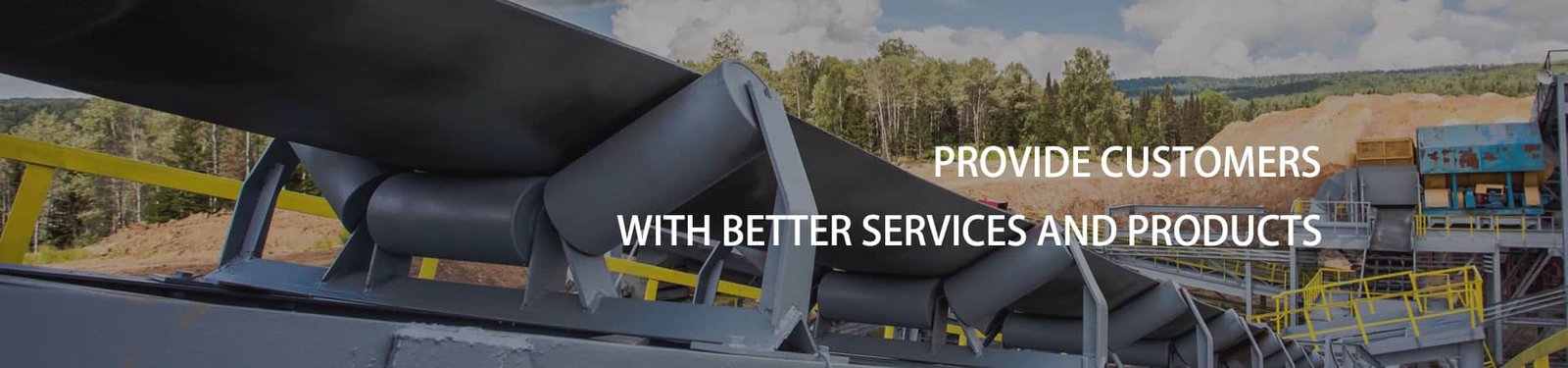
It is important to clarify one concept: idlers and drums are two key components with different functions in the conveyor system, but they work together to support and drive the conveyor belt.
To understand it more intuitively, we can compare it to a train system:
Conveyor belt = Railway track
Support rollers = sleepers evenly distributed beneath the rails (for support and guidance)
Roller = locomotive of the train (driving roller) or tail steering wheel (steering roller)
1. Idler rollers are the most numerous and widely distributed components, primarily used to support the conveyor belt and the weight of the material, reduce operational resistance, and ensure smooth operation of the conveyor belt.
1. Main types:
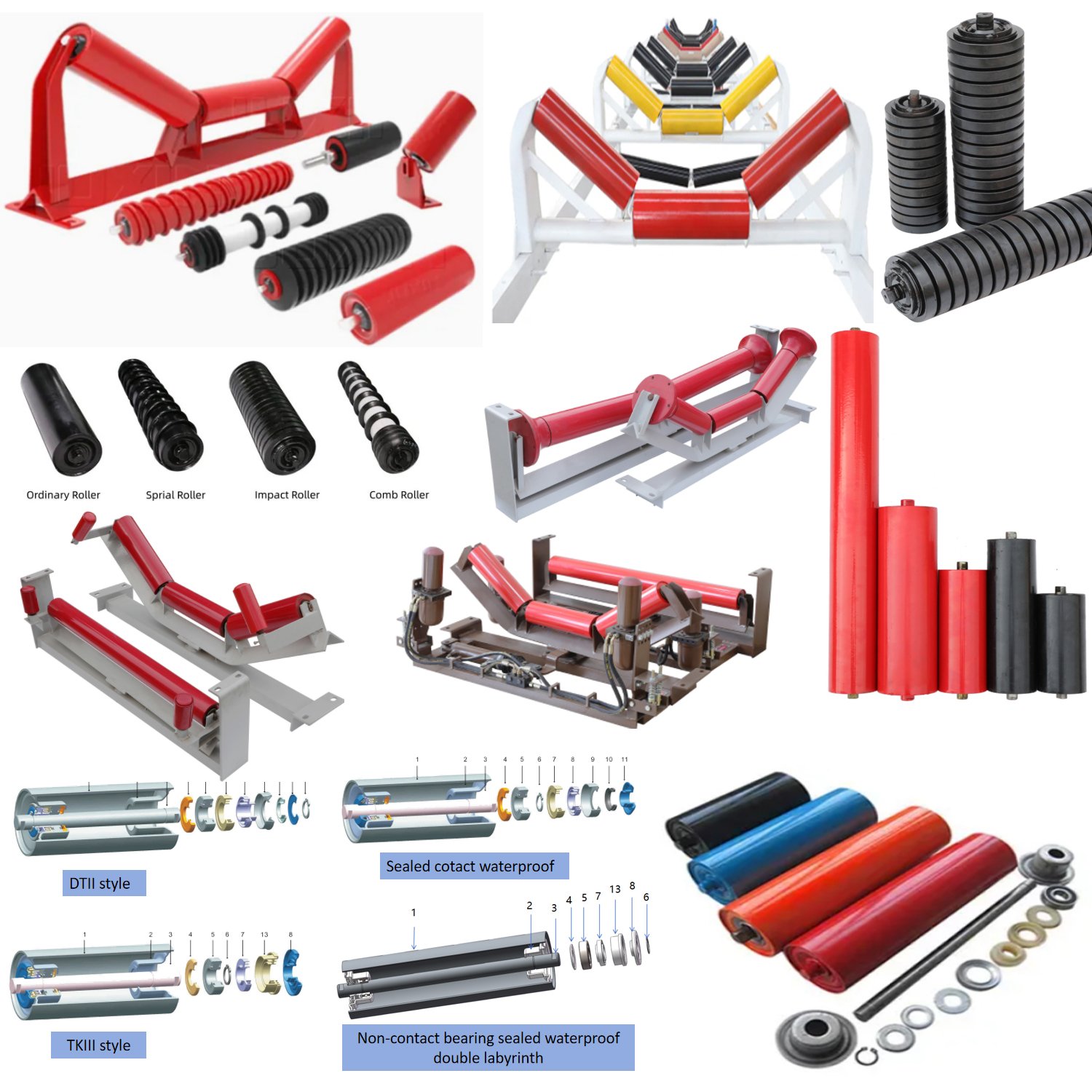
Grooved idler: The most commonly used type, typically consisting of 3 or 5 sections, forming a groove angle, used for carrying branches (upper branches) and increasing conveying capacity.
Parallel roller: A straight single roller used for conveying finished products or returning branches (lower branch).
Self-aligning idlers: Used to automatically correct the deviation of conveyor belts. Common types include V-shaped forward-tilting type, friction-based self-aligning type, etc.
Buffer roller: installed at the receiving point, with a rubber ring on the outside of the roller, used to absorb material impact and protect the conveyor belt. Usually in a groove shape or parallel.
Transition idler: installed between the drum and the groove-shaped idler section, it adopts a progressive groove angle design to reduce the edge stress of the conveyor belt and prevent belt tearing.
2. Structure and composition:
Roll body: Typically made of steel pipe (seamless steel pipe or straight seam welded pipe).
Bearing: The core component, commonly utilizing deep groove ball bearings or specialized roller bearings. Its quality directly determines the lifespan of the roller.
Sealing: Crucial! It prevents dust and moisture from entering the bearing. Common types include labyrinth seals, contact seals (such as Freudenberg seals), or multiple combined seals.
Shaft: Typically a stepped shaft, used for fixation and installation.
Tube end retainer/bearing seat: used to fix the position of the bearing.
3. Main failure modes:
Bearing seizure: Seal failure leading to dust ingress or lubricating grease deterioration.
Roller skin wear: Especially non-rotating idlers, they can be worn through by the conveyor belt.
Abnormal noise: Damaged bearing or poor lubrication.
Corrosion: It occurs in humid and corrosive environments.
II. Roller The roller is a component used to transmit power and change the direction of the conveyor belt, typically located at the head, tail, tensioning point, or convex arc section of the conveyor.
1. Main types (by function):
Drive roller: Power source. The motor transmits torque to the roller through a reducer, relying on the friction between the roller and the conveyor belt to drive the entire system. The surface is often covered with rubber (with herringbone or diamond patterns) to increase the friction coefficient.
Return roller: Used to change the direction of the conveyor belt (such as 180°, 90°, or a smaller angle of increase), or to increase the wrap angle of the conveyor belt on the drive roller. It is usually installed at the tail or tensioning device.
Increasing roller: A small type of deflection roller used to increase the wrap angle of the conveyor belt on the drive roller.
Tensioning roller: Combined with tensioning devices (such as weight carts, hydraulic cylinders), it provides and maintains the required tension for the conveyor belt.
2. Structure and composition:
Cylinder shell: The main structure, which is made by rolling and welding steel plates, requires sufficient rigidity and strength.
Web plate: A crucial force-transmitting component connecting the cylinder skin and the shaft.
Shaft: The core load-bearing component, which withstands bending moments and torques. The material is typically high-quality carbon steel or alloy steel.
Bearing seat: It supports the roller shaft and typically incorporates a self-aligning roller bearing, which can automatically adjust its alignment to accommodate certain installation errors.
Hub/expanding sleeve connection: In modern design, the spoke plate and shaft often utilize an expanding sleeve connection, which eliminates the need for keyways, offers high torque transmission, and ensures good alignment during installation.
Rubber coating layer: A layer of rubber that is thermally vulcanized or cold-bonded onto the surface of the drive roller. It is divided into:
Glossy adhesive: used in dry environments with low power consumption.
Herringbone/diamond pattern rubber: A mainstream choice, with good drainage and mud discharge performance, high friction coefficient, and directionality (the herringbone tips need to face the direction of movement).
3. Main design points:
Torque and power calculation
Conveyor belt tension analysis
Strength and stiffness verification of shaft
Bearing life calculation
Selection of encapsulation material and thickness
III. Coordination and Comparative Characteristics of Idlers and Drums Idler Drum Function Support, guide, drag reduction Drive, change direction, tension quantity Large quantity, continuous distribution Small quantity, key position movement Passive rotation (by friction) Active rotation (driven by drum) or passive rotation speed Relatively high Relatively low force Mainly bear radial load Bear radial load, torque, large axial force Maintenance focus Rotation flexibility, sealing, wear Bearing condition, rubber wear, concentricity, connection fastening IV. Key Considerations for Selection and Maintenance Operating conditions and environment:
Material characteristics: abrasiveness, acidity/alkalinity, humidity, temperature.
Environment: Indoor/Outdoor, Dry/Humid, Dusty/Containing Corrosive Gases.
Load: conveying capacity, belt speed, tension.
Selection principle:
Idler roller: Select the type according to the position (load-bearing/return/receiving); choose the roller diameter and bearing specifications based on the load; determine the sealing level according to the environment.
Drum: Determine the diameter, shaft diameter, and bearing model based on the function (drive/direction change) and force calculation; select the rubber coating type according to the friction requirements.
Maintenance points:
Routine inspection: Listen for abnormal noises, check for rotation (ensure the idlers are not spinning), inspect for belt misalignment, and observe wear (especially on the rubber coating and roller surface).
Regular maintenance: Clean, lubricate (as per the instructions), and replace damaged parts.
Preventive replacement: Batch replacement of components that have reached their service life or wear limit to avoid unexpected downtime.
In the conveyor belt system, the "idlers" serve as the bones, providing continuous and stable support, while the "drums" act like joints and muscles, providing power and controlling direction. The design, manufacturing, and quality of both directly determine the reliability, efficiency, energy consumption, and lifespan of the entire conveyor system. In practical engineering, precise calculations and reasonable selection must be made according to specific working conditions, and a scientific maintenance system must be established.
 Top 10 Conveyor Roller Supplie
 The Belt Conveyor System: A Co
 Comprehensive Analysis of Belt
 Key Components of Belt Conveyo