
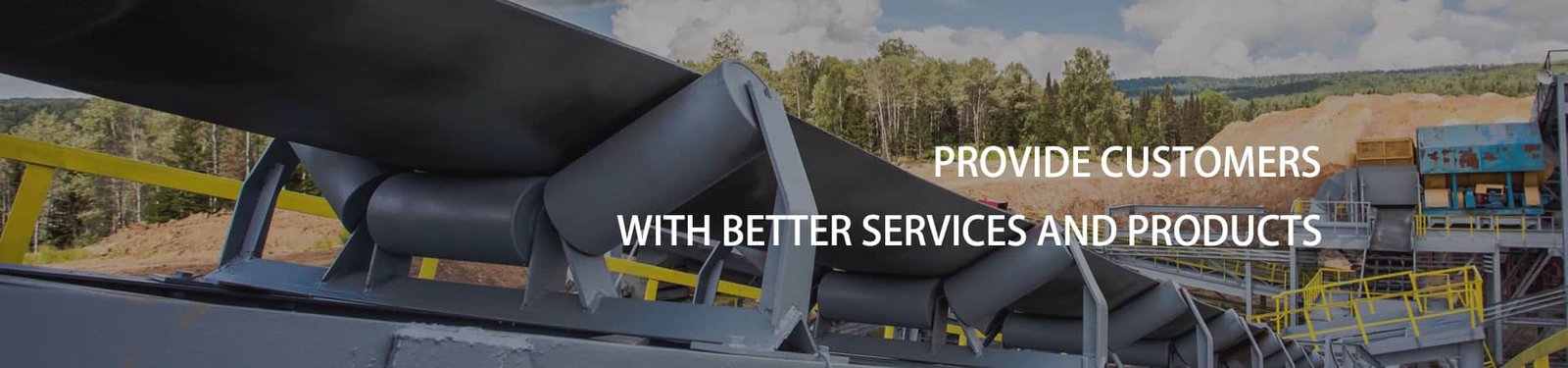
1. What is a roller?
The idler is a cylindrical rolling component installed on the frame of the belt conveyor, used to support the conveyor belt and materials, and reduce the running resistance of the conveyor belt. It acts like a "track for the conveyor belt", ensuring the belt runs smoothly and centered.
II. Main Types and Functions: According to their functions and installation positions, idlers are mainly divided into the following categories:
1. The load-bearing roller assembly is installed on the loaded branch (upper belt) of the conveyor, serving to support the material.
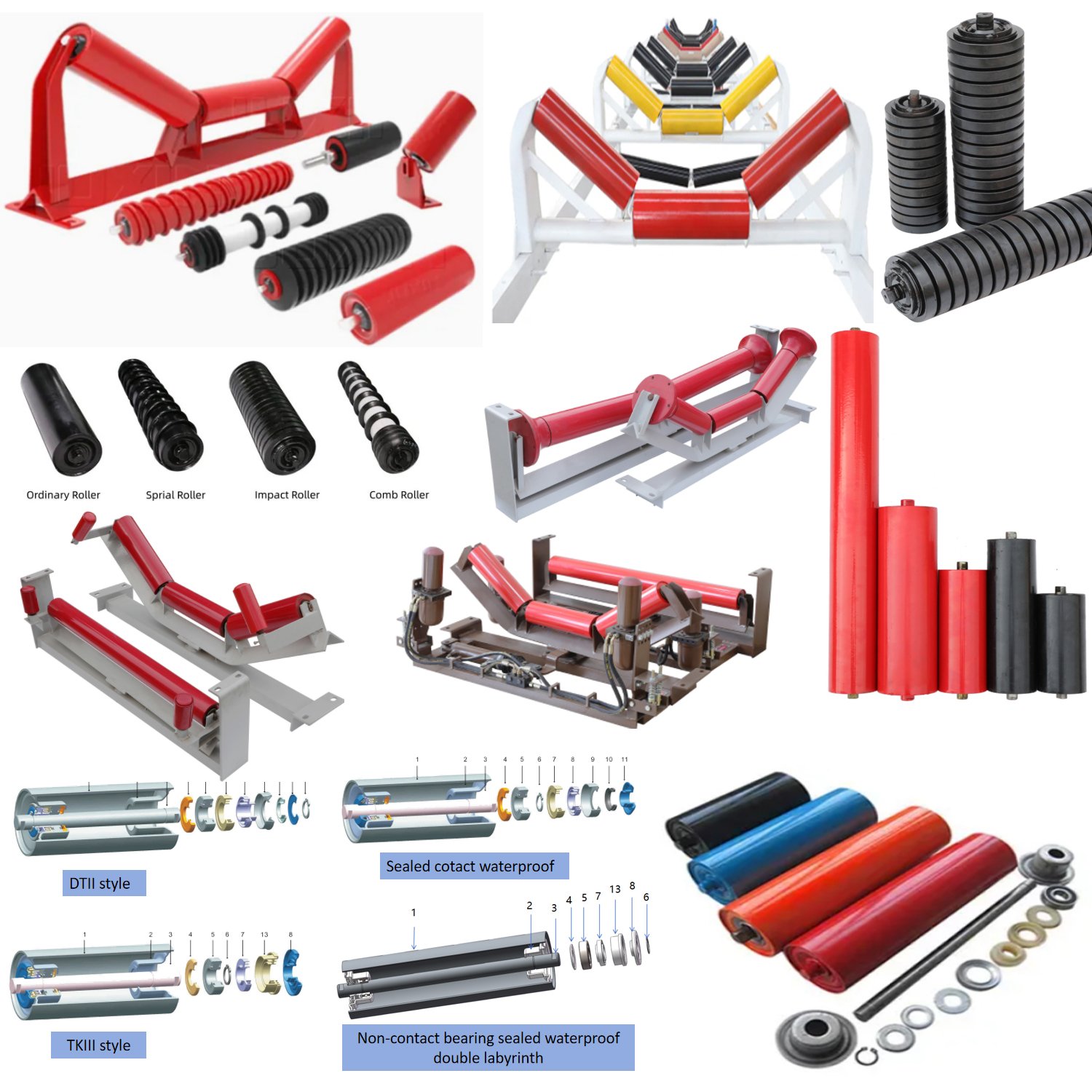
Grooved roller: The most common type. It consists of three (35° groove angle) or five rollers, forming a groove to increase conveying capacity and prevent material scattering.
Transition roller: installed between the head drum and the first set of grooved rollers, before the tail drum. The groove angle transitions gradually from a gentle angle to a standard groove angle. Its key function is to reduce the stress caused by excessive edge tension when the conveyor belt enters the drum, preventing belt tearing and damage.
Buffer roller: installed at the material receiving point (such as below the discharge opening). The roller is wrapped with an annular rubber ring, which is used to absorb the impact energy of large pieces of material falling down, protecting the conveyor belt and the roller itself.
Self-aligning idler: used to automatically correct belt misalignment. It is divided into:
Forward-tilting grooved roller: The rollers on both sides are tilted forward at a certain angle (usually 2°) to create an inward lateral friction force, which is simple and effective.
Friction-upward adjusting idler: When the belt deviates and touches the side vertical roller, the roller rotates through friction, driving the entire idler frame to rotate around the center point by a certain angle, generating a lateral force that pushes the belt back to the center, thus providing stronger deviation correction capability.
2. The return idler assembly is installed on the unloaded branch of the conveyor (lower belt) to support the belt returning without load.
Parallel lower roller: A single straight roller, which is the most commonly used.
V-shaped/V-shaped forward-tilted lower roller: Consisting of two inclined rollers forming a V shape, it enables the centering of the empty belt, especially showing significant effects in long-distance conveying.
Parallel comb/spiral roller: The roller surface features spiral grooves or protrusions, which effectively clean materials adhering to the non-working surface of the belt during rotation, preventing material buildup and belt deviation.
3. Special roller/upright roller: installed vertically on both sides of the conveyor, it restricts the belt from falling off in case of severe deviation and is a protective component.
Hanging roller: used for hanging conveyors, with certain self-adaptive ability to swing.
III. Core Structure and Technical Essentials The key to a high-quality roller lies in its internal structure:
Roller body:
Material: Seamless steel pipe (preferred) or high-frequency welded pipe. High requirements for roundness, straightness, and uniform wall thickness.
Diameter: Common diameters include φ89mm, φ108mm, φ133mm, φ159mm, etc. Larger diameters result in lower operating resistance and longer lifespan, but also higher cost.
Treatment: Performing stamping and necking or welding the bearing seat at both ends is a crucial process to ensure concentricity.
Bearing:
The "heart" of the roller. Commonly used deep groove ball bearings (such as 6204, 6205).
Large clearance bearing: Designed specifically for idlers, it has a larger internal clearance than standard bearings, allowing for lower rotational speeds and a certain degree of axial play to prevent seizure.
Sealing:
The "lifeline" of the roller. 99% of roller failures (stuck and not rotating) are caused by seal failures, which lead to the entry of dust and moisture into the bearing, resulting in contamination or loss of lubricating grease.
Mainstream sealing forms:
Labyrinth seal: Non-contact, multi-layered circuitous channels, utilizing air resistance to block contaminants. With minimal resistance and long lifespan, it is the mainstream choice for modern high-performance rollers.
Contact lip seal: The rubber lip is in close contact with the shaft, providing good initial sealing. However, it wears out quickly and loses its effectiveness, increasing rotational resistance.
Combined seal: "Maze + Lip" or "Maze + Fluororubber Oil Seal", combining the advantages of both, is used in extremely harsh environments.
Shaft and lubrication:
Shaft: Typically, it is a cold-drawn smooth shaft with high precision.
Lubrication: Most idlers adopt a lifelong maintenance-free lubrication system, with high-quality lithium-based grease filled once before leaving the factory. Some heavy-duty idlers are also designed with external oil nipples, allowing for regular replenishment of lubricating grease.
IV. Selection Guide: To choose the correct idler, the following factors should be considered:
Factors to Consider:Selection of Recommended Conveyor Materials:Ordinary Materials: Standard idlers.High abrasivity (such as ore): Thickened steel pipes or wear-resistant coatings.Corrosivity (such as salt, fertilizer): Galvanized, stainless steel, or plastic idlers.
Environmental conditions: Dusty: High-grade labyrinth seal. Damp/water wash: Waterproof seal or even fully sealed grease-filled structure. Outdoor/large temperature difference: Pay attention to bearing clearance and rust prevention treatment.
Conveyor parameters: Belt width: determines the length of the idlers (B+50mm ~ B+100mm). Belt speed and load: for high belt speeds and heavy loads, it is necessary to select idlers with large diameters and large bearing specifications to reduce rotational resistance and increase load capacity.
Installation location: At the receiving point, buffer rollers must be used. At the transition section, transition rollers must be used. For long-distance return sections, it is recommended to use V-shaped or comb-shaped rollers for centering and material cleaning.
V. Common faults and maintenance Main faults:
Failure to rotate/seizure: Seal failure, bearing damage, and poor lubrication are the most common faults.
Abnormal noise: damaged bearings, loose internal parts.
Roller skin wear: Especially non-rotating idlers, they can abrade the belt like a knife, causing huge losses.
Corrosion and rusting: Due to humid environment or materials not resistant to corrosion.
Maintenance points:
Daily inspection: Listen to the sound (for any abnormal noise), check the rotation (for any stalling), and observe the belt (for any wear or deviation caused by issues with the idlers).
Planned replacement: Don't wait until the roller is completely stuck before replacing it. A reasonable replacement cycle should be set based on the working conditions, and preventive replacement in batches should be carried out. This is more cost-effective than repairing after the fact.
Cleaning: Promptly clean up the materials that have fallen on the roller bracket to prevent them from affecting the rotation of the roller or accelerating wear.
Although the idlers of belt conveyors are small, they are crucial consumable components in the system. When selecting, one should not only focus on the initial procurement cost, but also comprehensively consider their sealing performance, rotational resistance, and service life. A high-quality idler brings low energy consumption, low belt wear, and low maintenance costs, which yields significant benefits in the long run.
Remember a simple formula: high-quality roller body + large clearance bearing + efficient labyrinth seal = long-lasting, low-resistance roller.
 Top 10 Conveyor Roller Supplie
 The Belt Conveyor System: A Co
 Comprehensive Analysis of Belt
 Key Components of Belt Conveyo